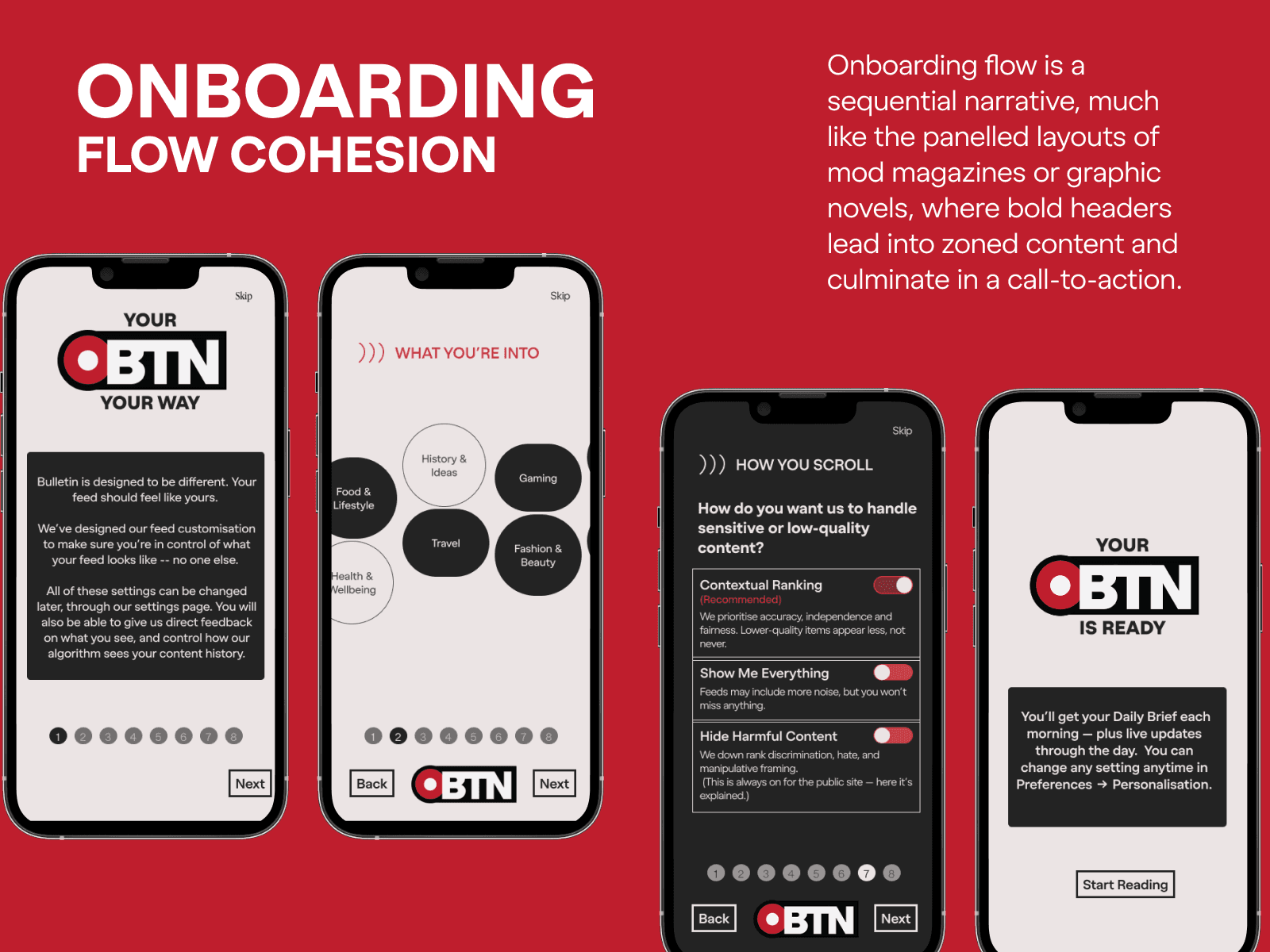
Omniana Product Strategy

Year:
2026
Category:
Interface Analysis
What happens when an app for reflection starts behaving like a productivity app?
Most platforms treat persuasive design as a default setting. Omniana doesn't — it refuses to gamify, streak, or score, and that refusal is the whole product. The problem is that a refusal is hard to market. The philosophy was fully present in the interface and almost entirely absent from the brand layer: onboarding, copy, content, and re-engagement all understated a commitment the product had already made. As users increasingly look for alternatives to social media and persuasive design, the opportunity wasn't to add a position — it was to name the one already there.
The audience is people who feel the texture of the algorithmic age in their daily lives — feed fatigue, the sense of attention being managed by someone other than themselves — and who are reaching for tools that take the formation of attention seriously rather than dressing up another optimisation regime. The brief had three goals: name Omniana's strengths with evidence, communicate them to users and a wider audience, and produce recommendations that protect what already works while finding the next leverage points.
the analysis
The method was Interface Analysis — reading the interface as evidence, not just as a set of tasks to complete. It treats a product as evidence of the business model, ideology, and power relations underneath it, and it changes the questions you ask: not "can the user complete the task" but which tasks the interface expects, who benefits, what's quietly omitted or encouraged, and what kind of person the product imagines its user to be.
The reading didn't happen in a vacuum. I triangulated against two weeks of structured daily use, a set of comparable products (Day One, Reflectly, Stoic), and a body of literature. Omniana's most distinctive positions showed up exactly where it refused features the comparators take for granted. Four texts did the theoretical scaffolding: Stiegler's The Age of Disruption, which made Omniana's recursive reflection legible as a structural counter-move to platform-driven distraction rather than a UX preference; Han's The Burnout Society, which locates contemporary exhaustion in the imperative to self-optimise and puts Omniana's restraint on the other side of that line; and Lovink (Stuck on the Platform) and Fry (Design Futuring) for the supporting frames.
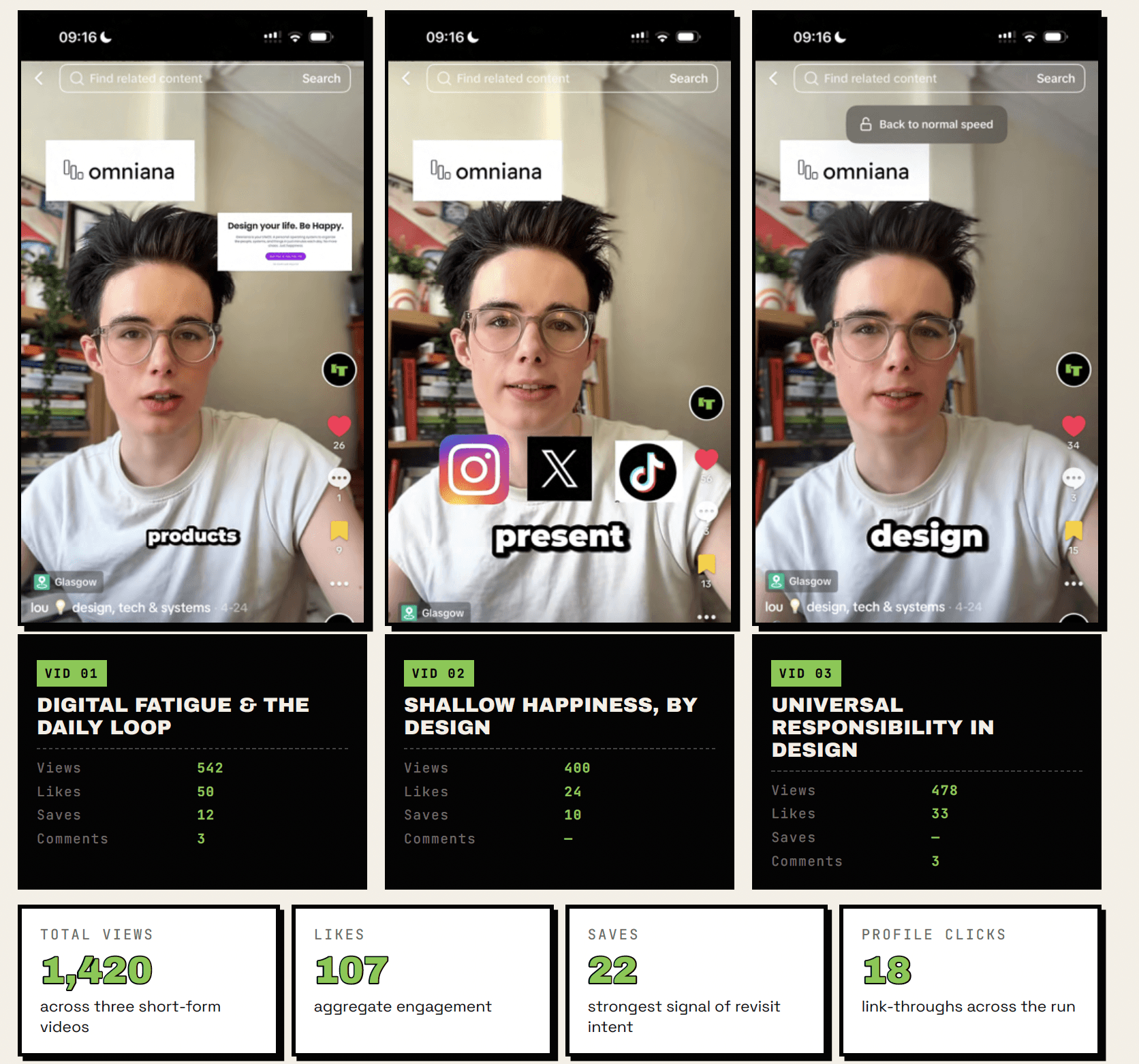
Before recommending a brand position, I tested whether anyone wanted it. Three short-form videos went out, each anchored on a theme from the first fortnight of use — digital fatigue and the daily loop, shallow-by-design, and happiness as a design responsibility. Together they pulled 1,420 views, 107 likes, 22 saves, and 18 profile clicks. Reach was even across all three, which told me the themes resonated broadly rather than one carrying the rest. The signal worth acting on was in the saves — the strongest proxy for intent to revisit — which concentrated hard on the digital-fatigue video. "Reground in a feed-flattened day" is the framing that lands, and it should anchor the brand voice going forward.
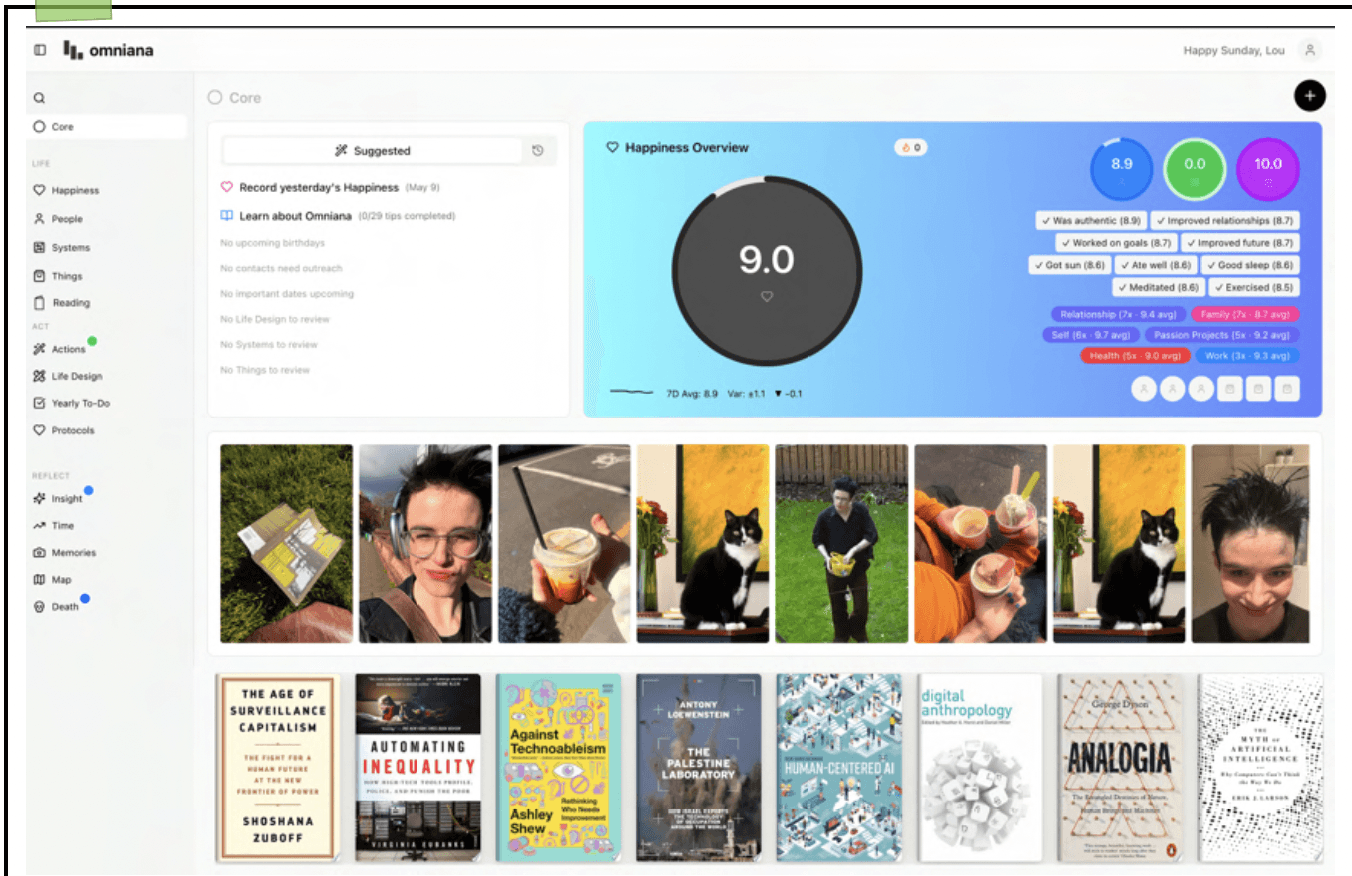
The findings consolidated into a smaller set of moves, each paired with a concrete prototype rather than a vague direction: an onboarding rewrite that leads with the belief before the buttons (Most apps start with what they do. We'd rather start with what we believe); email as the primary re-engagement surface, via a weekly prompt and a monthly summary that closes the feedback loop; a brand-voice essay series for the audience the videos proved exists; opt-in capture of context (weather, location, reading) that genuinely predicts the texture of a session; a mobile app for the moments reflection actually happens in; and a voice-input mode that lowers the cost of entry without lowering the depth.
the design
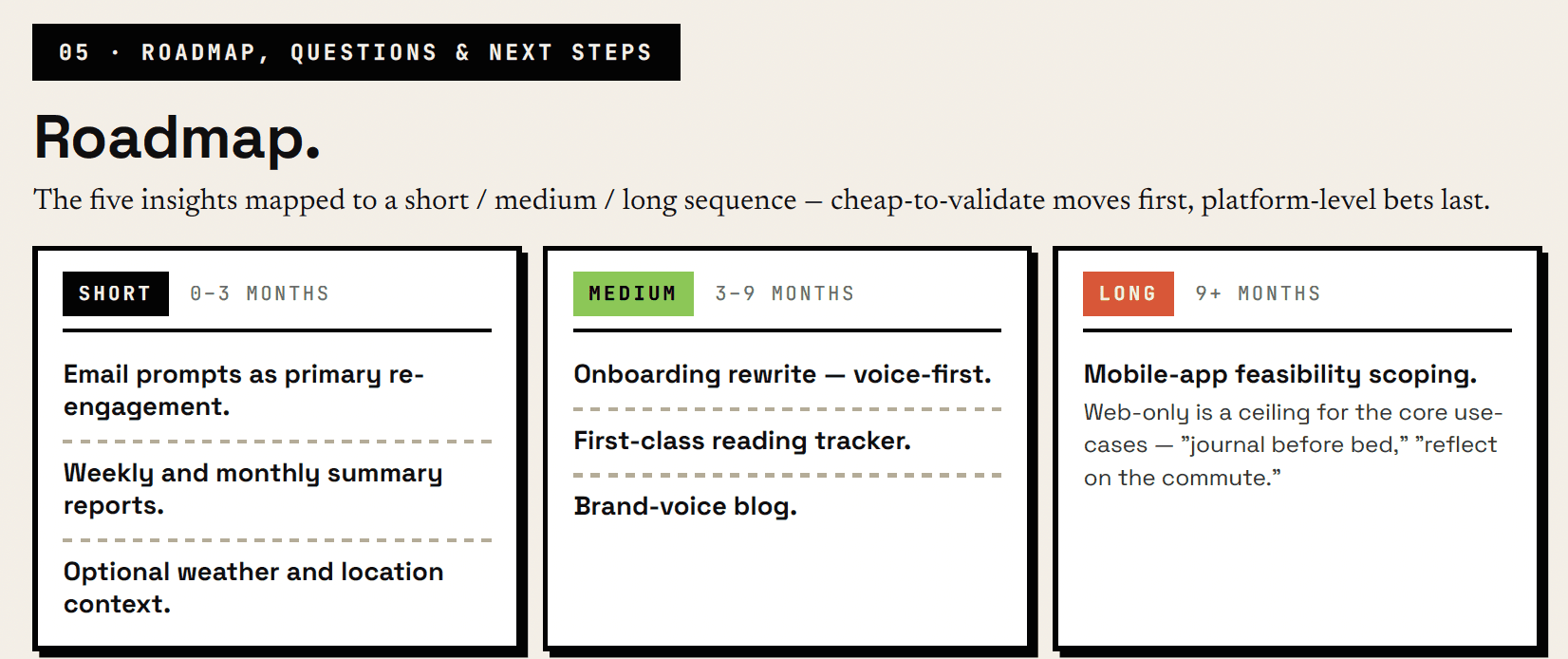
The point of a strategy isn't the deck — it's what survives contact with a roadmap. The recommendations were sequenced cheap-to-validate first, platform-level bets last, and the build since handover has followed that order. Two of the headline moves are now in production:
Voice input — live. The single biggest accessibility and activation gap is closed. Reflection is, for a lot of people, easier to speak than to type, and typing-only quietly excluded two groups at once — people for whom typed input is a barrier, and people whose reflective practice is already verbal. Omniana now ships a voice-input mode alongside typing, with on-device transcription to hold the line on analytics restraint.
The email programme — live, end to end. Across the six-week engagement I received exactly zero emails from Omniana; that's now reversed. The weekly prompt and the monthly summary — most-returned-to prompt, session length, mood trajectory — are both sending. Re-engagement went from the product's largest blind spot to one of its working surfaces.
A brand position named and evidenced. The analysis gave Omniana language for what it was already doing, tested in public before it was recommended — a foundation the team can carry across onboarding, content, and campaigns.
A sequenced roadmap. Five insights mapped across short, medium, and long horizons, each tied to a concrete prototype, so the team has a build order rather than a wishlist.
what's next?
Omniana is moving on the platform-level bets next. Weather and location context — lightweight, opt-in capture of the signals that predict the texture of a session — is in scoping, as is a mobile app, on the recommendation that web-only is a ceiling for the core use-cases: journal before bed, reflect on the commute. The medium-horizon work — a voice-first onboarding rewrite and the brand-voice essay series — is queued behind them. The roadmap was built to be revisited as the product grows, and the ongoing work is about keeping the brand layer honest to the position the product already holds.
If you're building something in this space — a product that refuses persuasive design and needs the strategy and brand to match — get in touch!