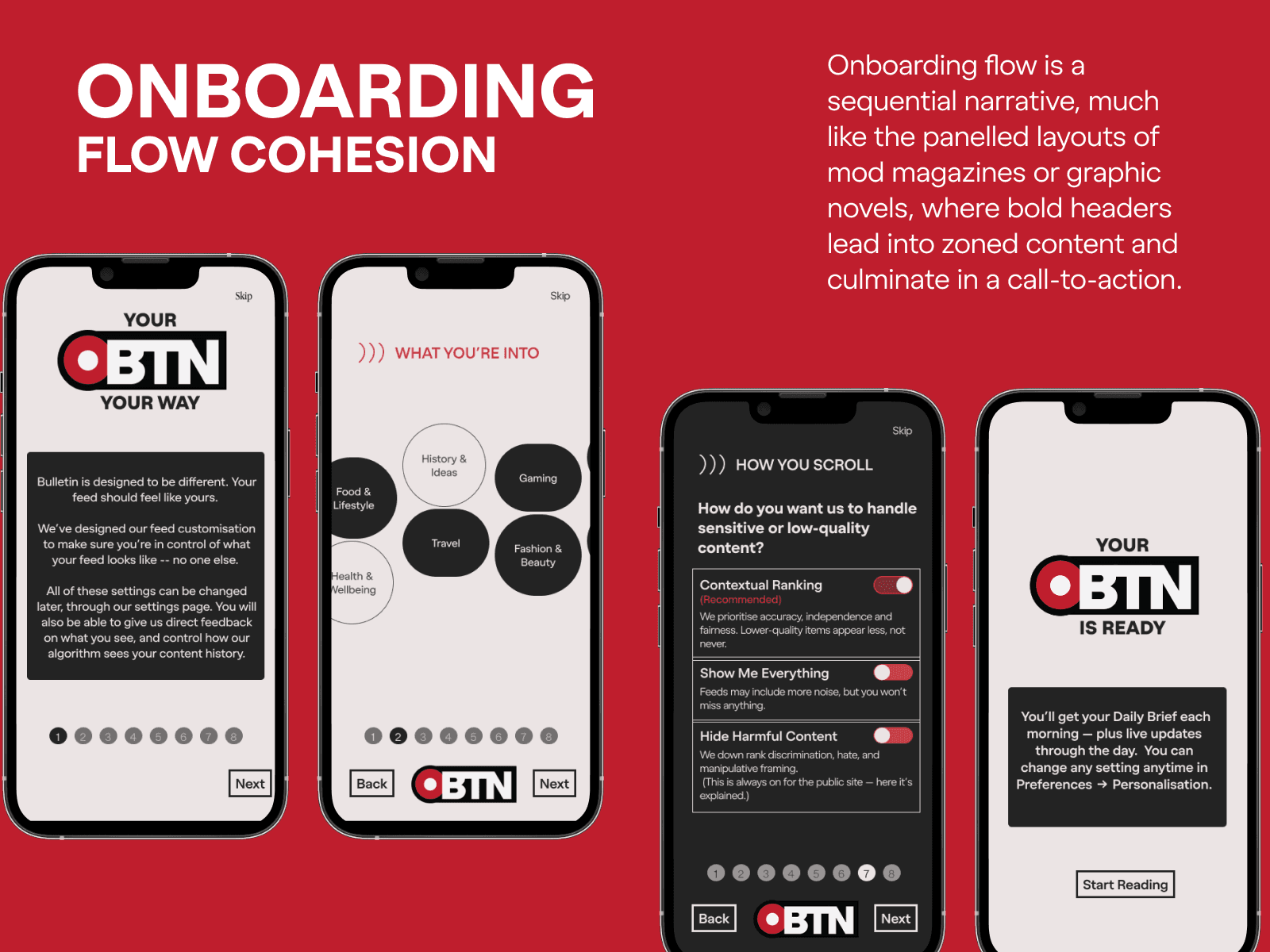
Turning strong opinions into a system

Year:
2026
Category:
Design Thinking
A founder had a lot of convictions and no way to turn them into output. How do you get from one to the other?
I was brought in to help a founder turn a large body of political thinking into something they could actually run.
The convictions were strong and clearly held: the media ecosystem is broken, disinformation is doing the damage, the answer is better analysis reaching more people, and AI would let one person produce it at scale. What didn't exist was any of the practical machinery. No defined product, no audience decision, no way of working, and nothing coming out the door.
That's a common shape for a founder-led project. The opinions are the reason it exists and also the reason it's stuck, because nobody has checked which of them are true and nothing has been built around the ones that are.
So I ran it as a design thinking project with a single question underneath: which of these opinions hold up, and what do we build so this person can produce every week without me?
Discover, define, develop, deliver. The output wasn't a strategy deck. It was a working system.
the analysis
The founder's opinions were the primary dataset, so I treated them like one.
I ran four to five hours of recorded video calls. Not scoping meetings. I asked about the beliefs directly and kept pushing on them: what's wrong with the media, why that is, who's failing and how, what should exist instead, who it's for, what a win looks like. Where an answer was vague I stayed on it until it was specific. Where two answers contradicted each other I left both in rather than tidying them up. The point was to get everything out, in their words, including the parts that hadn't been reasoned through yet.
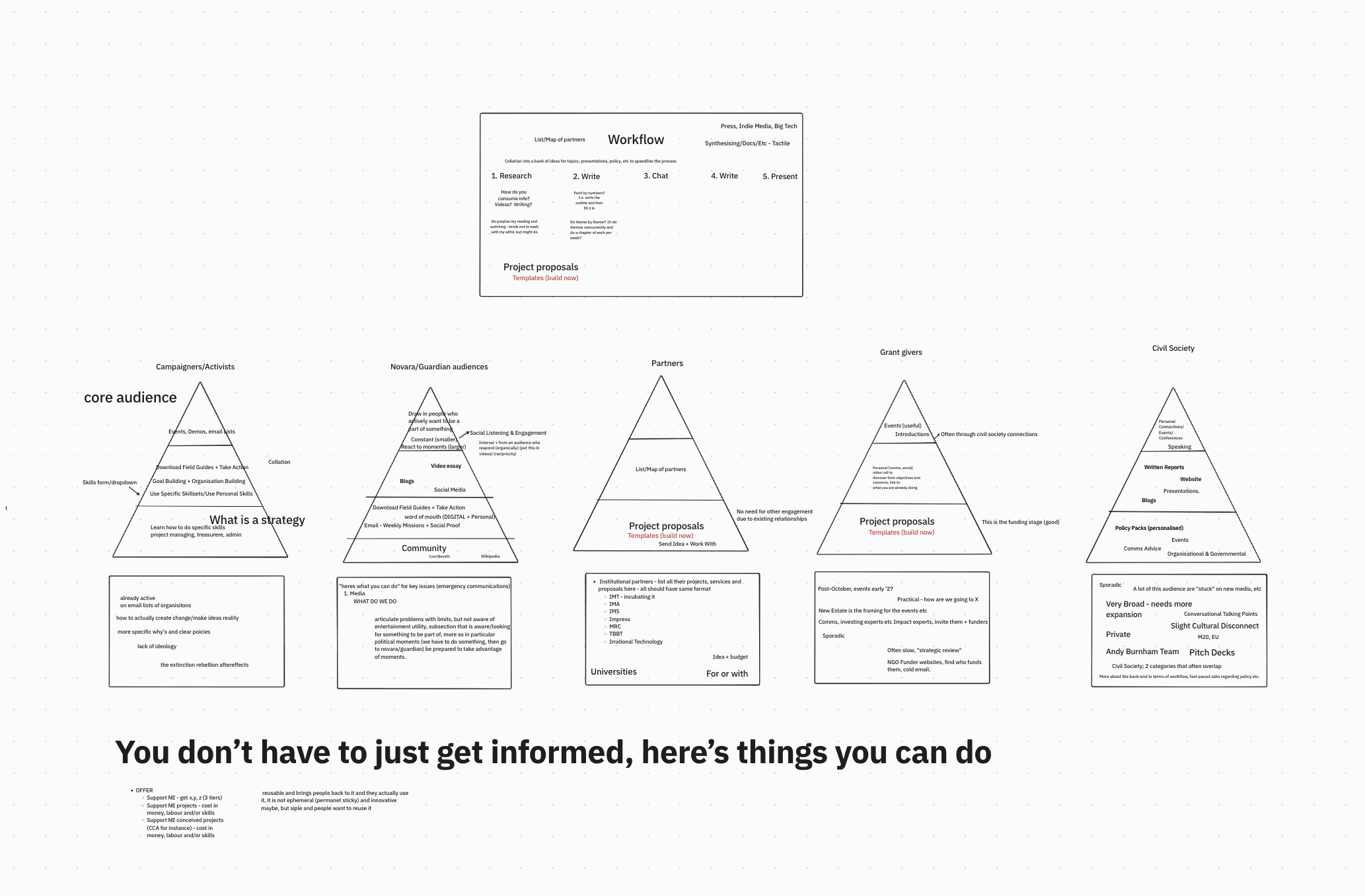
That gave me the same kind of raw material a focus group or an open-ended survey would, and I analysed it the same way. I coded the transcripts, clustered the codes into themes, and separated the things being stated as fact from the things being assumed. What came out was a manageable set of claims, each of which could now be checked against something other than conviction.
Then I checked them. I compared four organisations against the same five headings so the comparison was structural rather than a matter of taste: channels, positioning, audience, funding and output. Two were adjacent civil society projects. The other two, Novara Media and Guardian analysis, were the outlets the intended audience actually reads. I also ran a discourse analysis of the best-performing Novara and Guardian videos across six months to see what the audience turns up for.
The central claim came apart immediately. Novara and the Guardian sit at opposite ends of the left and fail in the same way. Novara lives on reader donations, which pays it to keep agreeing with the room. The Guardian lives on capital markets, which pays it to defend the order it depends on. Every funding model in the sample rewarded passive reading. The problem wasn't accuracy, and it wasn't argument. It was structural, and disinformation was a symptom sitting on top of it.
That changed the read on the audience. These readers aren't misinformed. They're media-literate, closely engaged and almost completely inactive. The incumbents are excellent at producing understanding and structurally unable to produce action, which is the gap, because no competitor's funding model lets them build into it.
The video work settled the rest. It clustered into seven recurring issues, which became the project's standing agenda. And it prompted the reframe that decided the audience question: instead of asking how to turn readers into actors, I asked which deficit we were solving first. Readers understand and don't move, so they need motivation. Campaigners already act but lack strategy and organisational know-how, so they need capability. Almost every campaigner is also a reader and not the other way round, so one product could serve both.
the design
The gap in the market was conversion rather than comprehension, so the output couldn't be another piece of analysis. Readers needed motivation and campaigners needed capability, so it had to work at both ends of the same funnel. And a solo operation is capped by one person's thinking, so whatever it was had to be produced once and reused, not written fresh for every channel.
What answers all three is a plan. That's the Field Guide, and it emerged from the constraints rather than being chosen as a format.
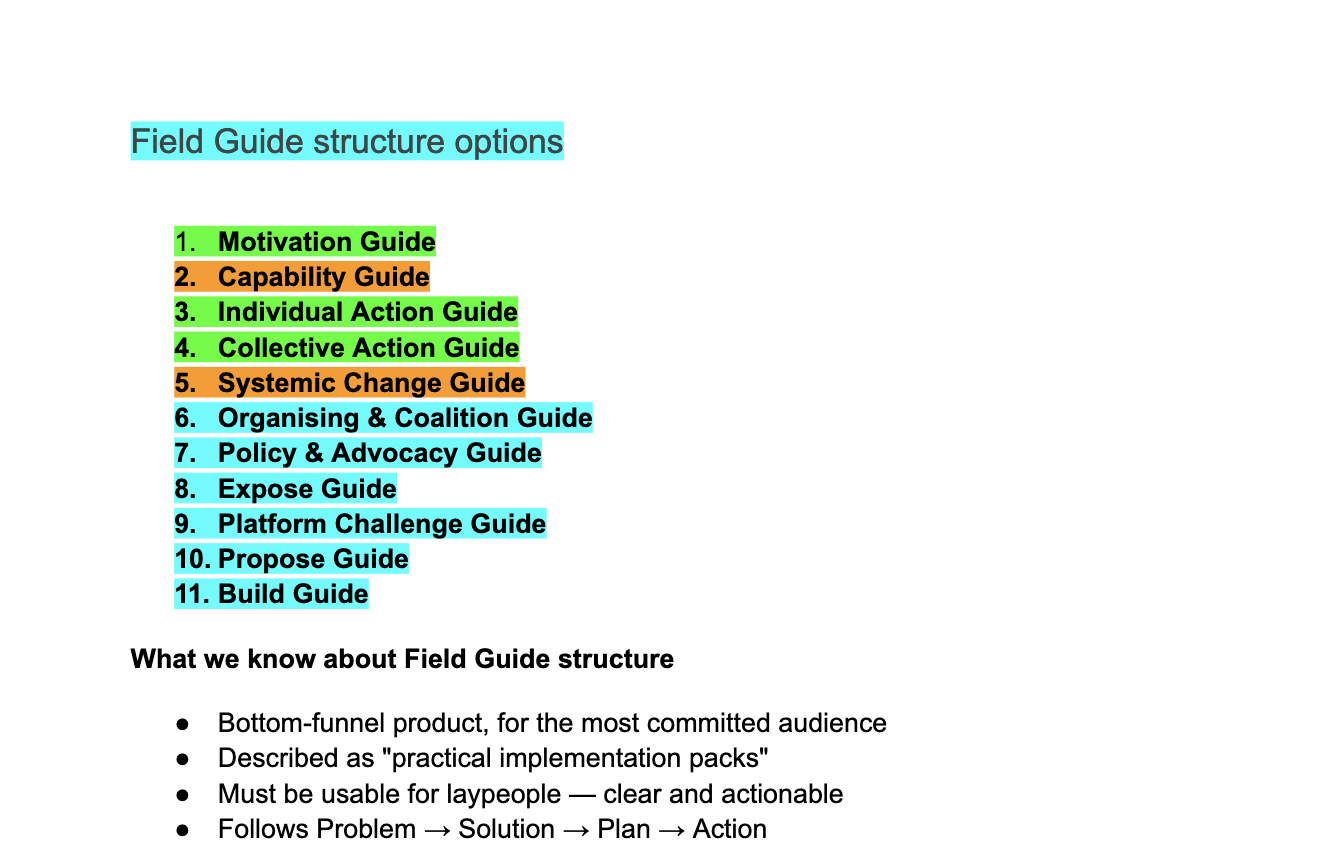
Defining it concretely meant deciding exactly what sits inside one, because "a plan" is not a brief. Problem, solution, elevator pitch, budget, labour, skills, timeline, partners, comms plan, power strategy, risks, funding strategy, tactics, organisational structure and legal status, counter-arguments. Every guide answers the same prompts. We built a set of guide types rather than one template. Video, infographics and social posts are then built backwards out of the finished guide to push people toward it.
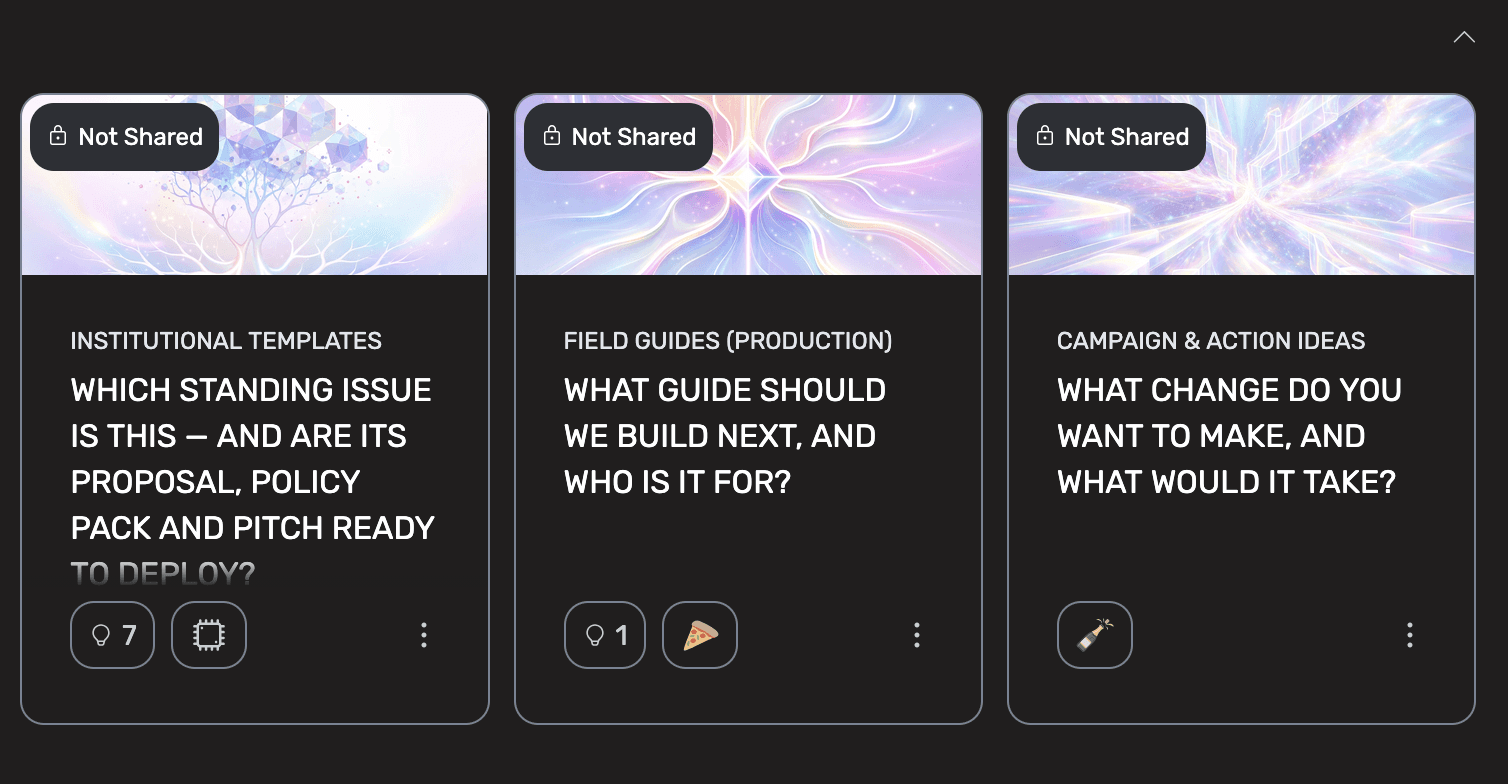
So I built it as a custom Ideanote workspace, structured around that shape rather than around generic innovation categories. Three spaces: campaign ideas, field guides, institutional templates. Everything tagged to the seven issues the discourse analysis surfaced. A guide moves through capture, scoping, strategy, drafting, review and live, and those stages are the guide's own sections in order. Each issue card runs its own version of the same route, from basics to ready, so a standing proposal sits on the shelf waiting for a news event.
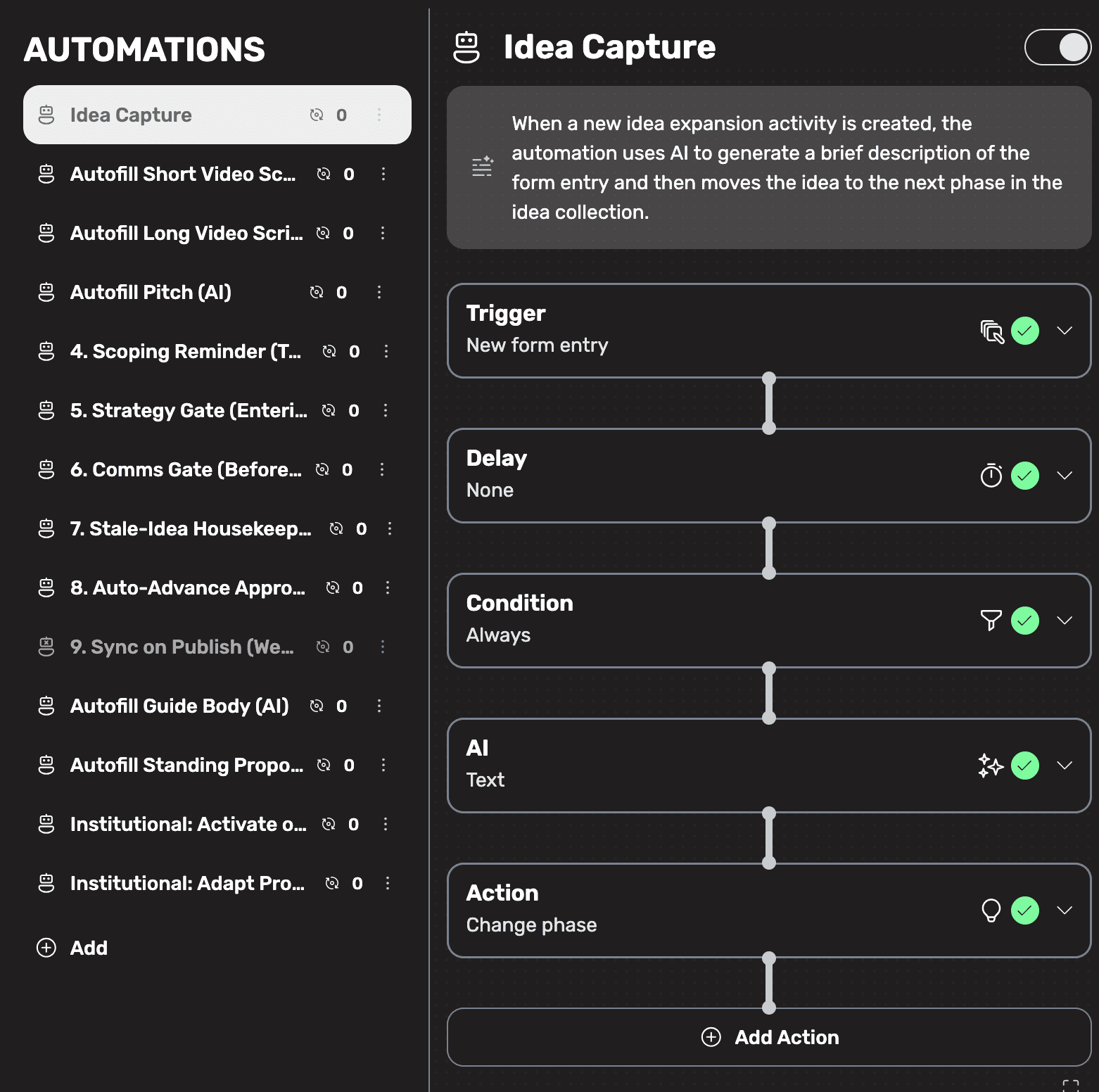
The automations were then written against that structure, which is only possible because the fields and stages are fixed. They do two jobs. Quality: an idea sitting in scoping with no labour filled in is flagged as needing work; an idea reaching drafting without tactics gets the same; one reaching live without an elevator pitch is blocked. Movement: anything left in capture for 45 days is parked; approved work advances on its own. On top of that, the AI drafts the guide body, the short video script, the long video script and the funder pitch from the brief captured at the start, and reshapes a standing proposal around a live topic the moment one is dropped into a ready issue card.
The division of labour is deliberate. The founder owns the framing and the stage where the argument and voice get set. The AI writes words. It does not make finished media: scripts still become videos, guide text still becomes a PDF, the pitch still becomes a deck.
One automation, pushing a finished guide out to an external CMS, is built but switched off, because Ideanote can't send data outside itself. Until that's wired through Zapier or Make, export is manual.